The useful part
- Choose the surface or task you want to improve before judging individual objects.
- Keep and display are different decisions; both can honor meaningful things.
- Use a dated not-today box when the decision is emotionally unclear, then revisit it without pressure.
Decluttering is useful when it restores a function: finding keys, opening a drawer, sitting at a table, or seeing the objects that matter. It becomes punishing when success is measured only by how much leaves. A sentimental home can remain full of history while becoming easier to use.
IKEA's 2026 global organization survey reported strong preference for lived-in homes and widespread sentimental keeping. Because the study spans 31 markets and comes from a home retailer, it should be read as a broad attitude signal rather than a rule for any one household. The practical answer is a system that makes room for meaning and daily life.
Name the function you want back
Begin with one small boundary: a drawer, one shelf, or the top of a dresser. Finish the sentence, I want this space to let me do or find something. That goal is more stable than a target number of items and makes each decision easier to explain.
Remove everything only if the category and space are small enough to finish in the available time. Otherwise, work front to back. Protect exits, heaters, and walking paths, and stop before creating piles that prevent normal use of the room.
Keep this in mind
- Define one physical boundary.
- Write the function the space should serve.
- Set a stopping time and preserve a clear path.
- Prepare destinations for display, containment, donation, recycling, and trash.
- Keep private papers and identifying information out of donation boxes.
Sources: IKEA
Use four actions instead of one discard pile
Keep means the object is useful and has a workable home. Display means seeing it is part of its value, so it deserves a safe, intentional place. Contain means a group matters but does not need constant visibility. Release means its function or meaning can travel elsewhere through donation, gifting, recycling, or disposal.
An object can move between categories. A stack of letters may be contained now, then edited and displayed later. A family serving piece may stay because it is used, not because it passes an aesthetic test. Decisions become clearer when they describe the object's role instead of your virtue.
| Action | Choose it when | Give it | Revisit when |
|---|---|---|---|
| Keep | It is used and its home works | A reachable, stable location | It blocks another needed function |
| Display | Seeing it is part of the value | Breathing room and secure support | The display becomes crowded or unsafe |
| Contain | The group matters but needs boundaries | One labeled, appropriately sized container | The container is full or hard to access |
| Release | Use and meaning no longer require ownership | A specific responsible destination | Before it returns to a maybe pile |
Sources: IKEA
Create a not-today box with a date
Uncertainty is a real outcome. Place genuinely unresolved items in one box, write the date and category on it, and schedule a review. Do not use several unmarked bins; that converts a decision pause into invisible storage growth.
At review, ask whether you looked for the item, remembered it without seeing it, or discovered a better home. Photographing an object may preserve information but cannot replace its texture, use, or personal meaning. Treat a photo as an option, not a universal answer.
Sources: IKEA
Make meaningful objects easier to see safely
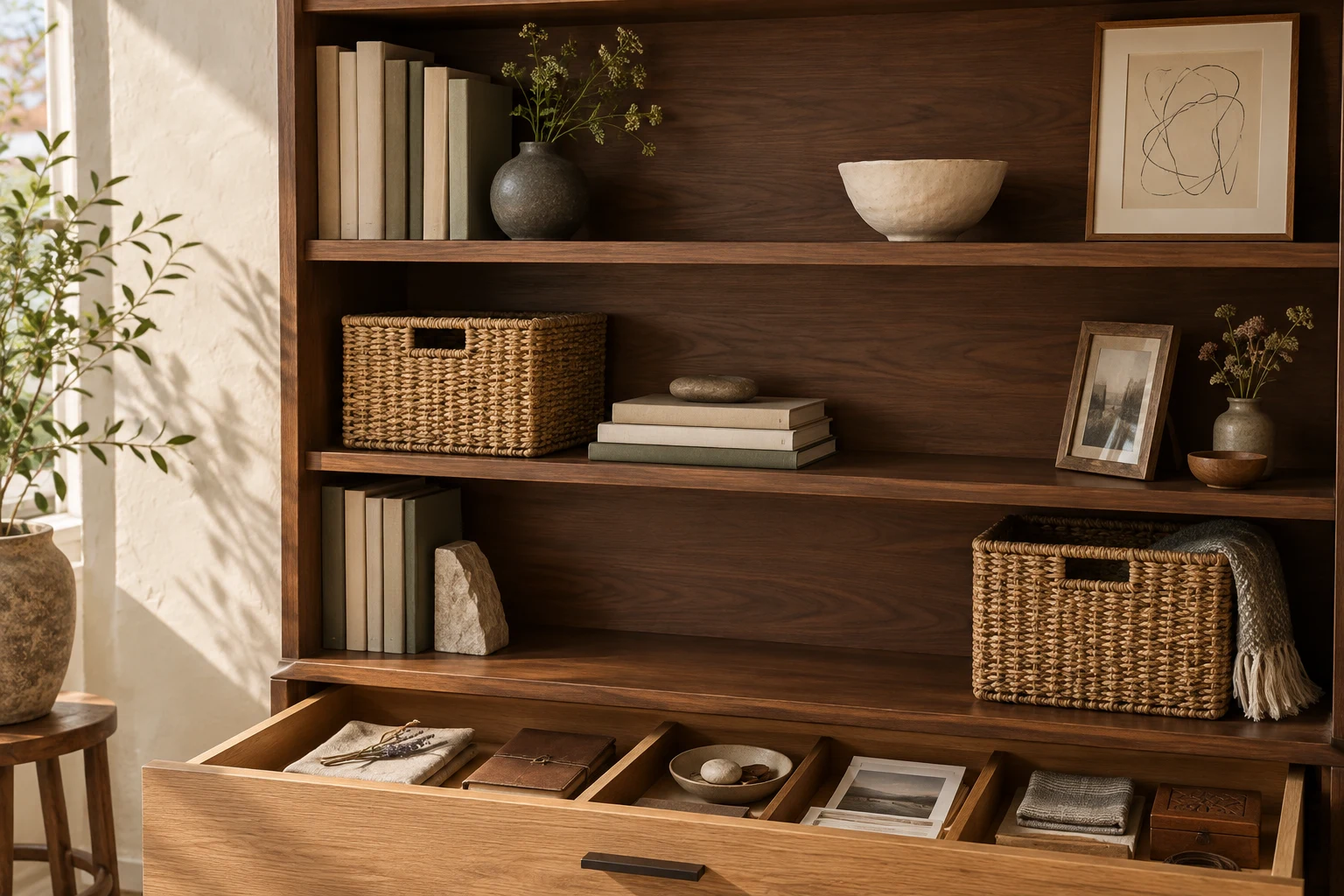
Group a few objects by person, place, material, or color and leave open space around them. Rotate fragile or seasonal pieces rather than forcing all of them onto one shelf. Use archival materials for vulnerable paper and photographs when preservation matters, checking the supplier's actual specifications.
Tall cases, dressers, and display furniture need stable placement and, where applicable, anchoring. The Consumer Product Safety Commission recommends anchoring furniture and televisions. Follow product instructions and choose mounting hardware for the wall and load; place breakable objects with children, pets, and everyday reach in mind.
Finish with a one-drawer experiment
Return only the chosen keep items, add a divider only if it solves a defined problem, and label the zone in plain language. Use the drawer for a week. If items migrate, the categories may be too fussy or the location may be wrong.
The result should be easier retrieval, not an empty photograph. Carry the system to another space only after the experiment works. A home can hold books, craft, inherited objects, and visible life while still offering a clear surface and a place to put things away.
Sources: IKEA
Sources & further reading
Factual guidance is grounded in the sources below. Styling suggestions and decision aids are our editorial interpretation.
- IKEA Store and Organize Report 2026IKEA · Accessed October 1, 2026
- Anchor It!U.S. Consumer Product Safety Commission · Accessed October 1, 2026
- 2026 Spring Cleaning SurveyAmerican Cleaning Institute · Accessed October 1, 2026
Written with care
Our aim is useful guidance, clear evidence, and considered choices. Found something that needs a second look? Tell us about a correction.