The useful part
- Protect one empty preparation zone before organizing appliances or decor.
- Give coffee, charging, and incoming items boundaries based on their actual use.
- Measure usable counter space and cabinet clearance before choosing trays, inserts, or small storage.
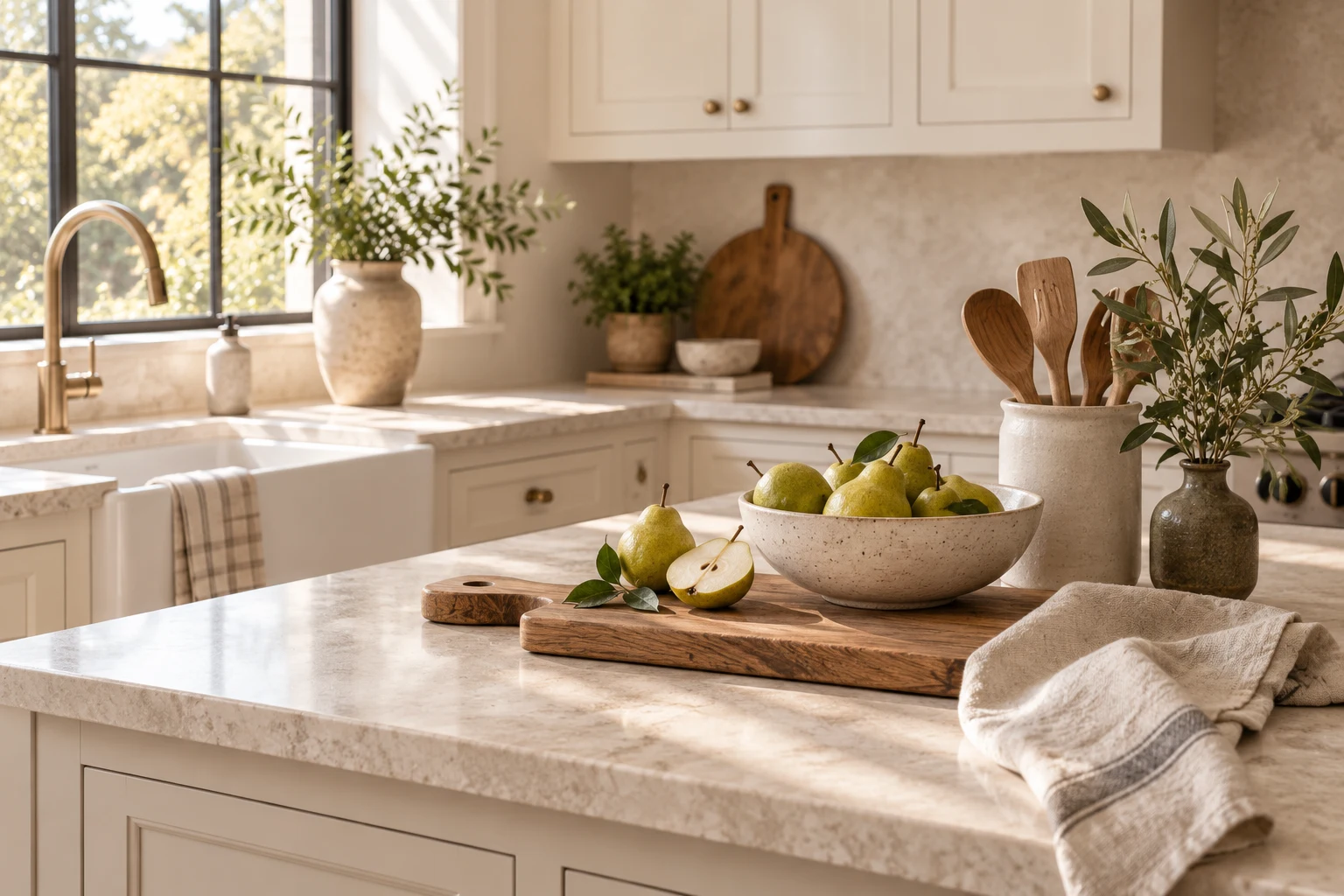
The kitchen counter becomes a conflict zone because it hosts preparation, appliances, papers, charging, drinks, and whatever just entered the house. The reset is not to hide every object. It is to decide which jobs the counter can support and how much space each job gets.
IKEA's 2026 Store and Organize report drew on a YouGov survey across 31 markets, including the United States, and identified the countertop as a common clutter problem. Its headline findings are global and brand-sponsored, so they should not be presented as U.S.-only behavior. They do support a practical premise: shared surfaces need visible agreements.
Measure the counter you can actually use
Remove loose objects, then measure each uninterrupted counter run. Subtract the space needed to open appliance lids, cabinet doors, and drawers. Mark where water splashes, heat reaches, and cords can connect without crossing the sink or preparation area.
Record the footprint of every appliance that lives out. An appliance earns permanent space when it is used often enough and can operate safely there. Otherwise, identify an accessible cabinet destination before moving it. Do not buy an appliance garage or tray until the handles, hinges, ventilation, and full operating height are measured.
Keep this in mind
- Counter length and depth by uninterrupted run
- Clearance under upper cabinets
- Door, drawer, and appliance-lid swing
- Outlet locations and cord length
- One uninterrupted food-preparation area
Sources: IKEA
Assign five zones with hard edges
The five zones are preparation, beverage, charging, drop zone, and leave empty. Preparation gets the safest continuous space near the tools you use. Beverage contains the coffee or tea routine. Charging stays away from sinks and food work. The drop zone catches incoming paper and keys briefly. Leave empty is a deliberate visual and functional buffer.
Use painter's tape for two days to test boundaries. If objects repeatedly cross a line, decide whether the boundary is wrong or the object lacks a home. The empty zone should remain empty, not become overflow. Its job is to absorb a grocery bag, a hot pan on a suitable trivet, or the daily shift between cooking and cleanup.
| Zone | Lives here | Boundary | Reset cue |
|---|---|---|---|
| Prepare | Board and current ingredients | Largest clear safe work area | Clear after each meal |
| Beverage | Daily machine, kettle, or supplies | One tray or measured counter segment | Return cups and refill only essentials |
| Charge | Approved chargers away from water | One cord-managed point | Remove charged devices |
| Drop | Today's paper, keys, outgoing item | One shallow tray | Empty at a fixed daily time |
| Leave empty | Nothing permanent | Visible uninterrupted surface | Protect it from overflow |
Sources: IKEA
Contain only after the map works
A tray is useful when it defines a zone and lifts as one unit for cleaning. It is unhelpful when it collects unrelated objects. Drawer inserts work when they match the drawer and tools; vertical racks work when they remain stable and do not crowd the backsplash or outlets.
Choose materials that suit the location and follow their care instructions. For cleaning products, use label directions and keep chemicals away from food and out of reach of children and pets. EPA's Safer Choice label can help identify products that have met the program's criteria, but any product still needs to be used as directed.
Sources: U.S. Environmental Protection Agency
Keep storage stable and preparation separate
Avoid tall stacks at the counter edge and do not use a freestanding shelf as a shortcut around overloaded cabinets. Secure tip-prone furniture and follow manufacturer installation directions. CPSC guidance focuses on anchoring furniture and televisions; the same habit of checking stability matters when adding storage near active work zones.
Keep raw-food preparation separate from papers, devices, and decorative objects. Clean the work surface with a product appropriate for that material and the task. A counter can look calm and still fail functionally if the only open patch is beside a splash zone or under a low cabinet.
Sources: U.S. Consumer Product Safety Commission; U.S. Environmental Protection Agency
Use a fifteen-minute weekly reset
Set a timer and work left to right. Return anything that belongs elsewhere, empty the drop tray, wipe the appropriate surfaces, refill only supplies used during the coming week, and restore the empty zone. Stop when the map is functional; reorganizing every cabinet is a different project.
If one zone repeatedly overflows, reduce its inventory or move the function. A mail tray that fills for weeks belongs near the place mail is processed, not necessarily in the kitchen. The five-zone plan succeeds when the counter recovers quickly after real life, not when it remains untouched.
Sources: IKEA
Sources & further reading
Factual guidance is grounded in the sources below. Styling suggestions and decision aids are our editorial interpretation.
- IKEA Store and Organize Report 2026IKEA · Accessed October 1, 2026
- Safer Choice ProductsU.S. Environmental Protection Agency · Accessed October 1, 2026
- Anchor It!U.S. Consumer Product Safety Commission · Accessed October 1, 2026
Written with care
Our aim is useful guidance, clear evidence, and considered choices. Found something that needs a second look? Tell us about a correction.