This article provides general information drawn from the sources below. It has not received an independent specialist review and cannot account for your individual health or safety needs.
The useful part
- Work in small sections so perishable food spends as little time as possible outside refrigeration.
- Use official storage guidance, product labels, and recall notices instead of smell or appearance alone.
- Clean with hot, soapy water and rinse; sanitize only when the situation calls for it and follow official directions.
A refrigerator reset is a food-handling task before it is an organizing project. The order matters: keep food safely cold, decide what can remain, clean the appliance, then return items where spills and raw-food leaks are easier to contain.
There is no prize for pretending every container has a clear history. A calm routine is more useful than shame, and food decisions should come from USDA and FoodSafety.gov guidance rather than smell, appearance, or optimism alone.
Prepare a cold, contained workspace
Choose a time when groceries are low. Gather a cooler with cold sources if the job may take long, hot soapy water, clean cloths, towels, trash and compost destinations where applicable, and a marker for labels. Check the appliance manual before removing shelves or using any cleaner.
Work one shelf or drawer at a time and return safe food promptly. USDA advises keeping the refrigerator at 40 degrees Fahrenheit or below. If perishable food has been at room temperature beyond official limits, follow USDA discard guidance rather than resetting the clock by putting it back.
Keep this in mind
- Confirm the refrigerator is at 40°F or below with an appliance thermometer.
- Set up a cooler if food cannot stay cold during the work.
- Keep raw meat or poultry packages contained away from ready-to-eat foods.
- Check current recall notices when a product is in question.
- Follow the appliance manual for shelf removal and cleaning.
Sources: USDA Food Safety and Inspection Service; FoodSafety.gov; USDA Food Safety and Inspection Service
Use clean, keep, freeze, or discard
Clean applies to sealed containers with sticky exteriors and sound food inside. Keep applies when the food is within applicable storage guidance and has been handled safely. Freeze applies when a suitable food is still safe but will not be used in time. Discard applies when official time or handling limits have been exceeded, a recall directs disposal, or spoilage is evident.
Do not taste food to decide whether it is safe. The FoodSafety.gov cold-storage chart gives item-specific refrigerator and freezer guidance, and USDA says cooked leftovers are generally refrigerated for three to four days. Package dates have different meanings across products, so use the relevant official guidance and label rather than one blanket rule.
| Decision | Use when | Next action |
|---|---|---|
| Clean | Container exterior is soiled; food remains safely stored | Wipe container appropriately and return promptly |
| Keep | Handling and storage fit current guidance | Place in a visible, appropriate zone |
| Freeze | Food is safe and suitable for freezing but will not be used soon | Package, label contents and date, freeze promptly |
| Discard | Recall, unsafe time or temperature, or spoilage applies | Follow recall or local disposal directions; clean affected area |
Sources: FoodSafety.gov; USDA Food Safety and Inspection Service
Clean first; sanitize for a reason
USDA's refrigerator-cleaning guidance says to wipe spills promptly, clean interior surfaces thoroughly with hot, soapy water, and rinse. Avoid solvents, abrasives, and cleaners that could damage the finish or affect food or ice. Let removable parts warm enough to avoid thermal shock and follow the manual.
CDC advises cleaning before sanitizing or disinfecting. Sanitizing the refrigerator may be appropriate after a recalled food contamination event; follow the recall notice and current CDC or USDA directions. Never mix products, label any diluted solution, ventilate as directed, and keep chemicals away from food.
Sources: USDA Food Safety and Inspection Service; Centers for Disease Control and Prevention
Return food in spill-aware zones
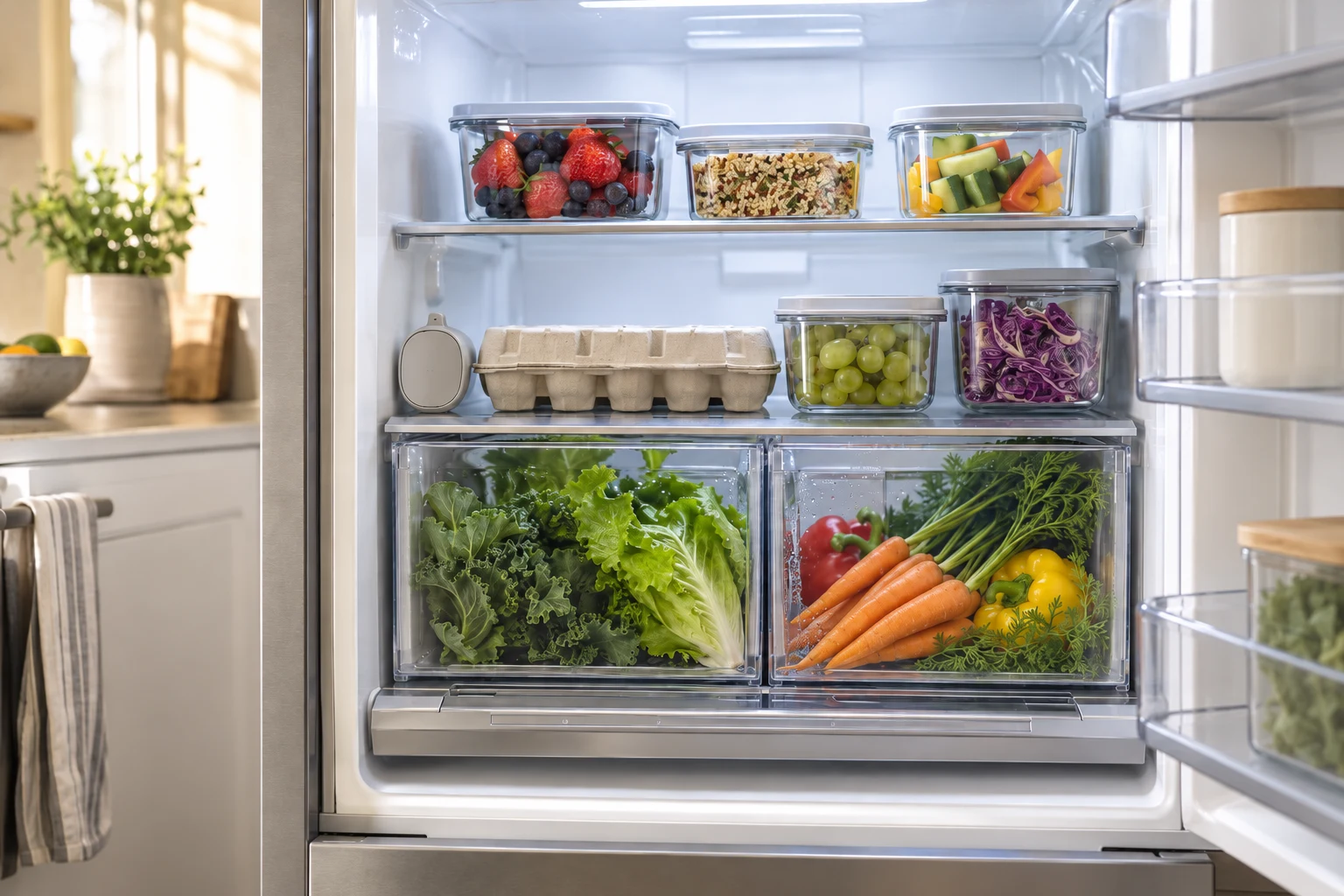
Put ready-to-eat foods where they are visible and raw meat, poultry, or seafood in a leakproof container positioned to prevent juices from reaching other food. Use drawers as designed by the manufacturer. Avoid overpacking if it blocks circulation, and do not assume every door shelf is suitable for every perishable item.
Label leftovers with the contents and preparation date. A first-to-use area can reduce forgetting, but it does not extend storage time. Bins should be removable, washable, and sized so they do not hide food in a second row or prevent the door from closing.
Sources: FoodSafety.gov; USDA Food Safety and Inspection Service
Prevent the next deep-clean emergency
Once a week, check leftovers against current guidance, wipe new spills, and scan the first-to-use area. Before shopping, photograph or list what needs to be used. Keep the thermometer visible and investigate a temperature that rises above the safe range.
Product organizers and thermometers cannot make mishandled food safe, and an attractive refrigerator image cannot demonstrate correct temperature or sanitation. The useful finish line is a cold appliance, clean surfaces, contained risks, and food you can identify.
Sources: USDA Food Safety and Inspection Service; FoodSafety.gov
Sources & further reading
Factual guidance is grounded in the sources below. Styling suggestions and decision aids are our editorial interpretation.
- How Do You Clean a Refrigerator?USDA Food Safety and Inspection Service · Accessed October 1, 2026
- Cold Food Storage ChartFoodSafety.gov · Accessed October 1, 2026
- Leftovers and Food SafetyUSDA Food Safety and Inspection Service · Accessed October 1, 2026
- When and How to Clean and Disinfect Your HomeCenters for Disease Control and Prevention · Accessed October 1, 2026
Written with care
Our aim is useful guidance, clear evidence, and considered choices. Found something that needs a second look? Tell us about a correction.