This article provides general information drawn from the sources below. It has not received an independent specialist review and cannot account for your individual health or safety needs.
The useful part
- Choose the capacity you want to practice before choosing a class or movement label.
- A clear floor, stable support, safe transitions, and an accessible exit matter more than decorative equipment.
- Movement selection, progression, regressions, and stop criteria require qualified review, especially with falls, pain, dizziness, or health conditions.
A small practice area can support useful movement when its limits are treated as design inputs. Balance, mobility, and core are broad labels, not interchangeable workouts. A standing balance task, seated mobility sequence, and floor-based core class place very different demands on space, transitions, support, vision, and confidence.
ACSM’s 2026 forecast lists balance, flow, and core strength as a prominent professional trend. That forecast describes industry attention, not the safety or efficacy of a particular routine. This planning guide does not prescribe movements. If a health condition or difficulty with balance makes movement uncertain, discuss safe options with a clinician or qualified exercise professional.
Name the capacity you want to practice
Start with a functional question. Do you want more confidence changing direction, enough comfortable range to reach a shelf, better control when rising, or an activity that helps you notice posture and breathing? The answer points toward a professional assessment and a practice category without assuming the cause of difficulty.
Balance can involve vision, sensation, strength, medications, inner-ear function, and the environment. Mobility can refer to usable motion in different joints and tasks. Core training can involve control and force transfer rather than a particular appearance. If a change is sudden, worsening, painful, or accompanied by dizziness or falls, seek appropriate clinical guidance before selecting a routine.
Sources: Centers for Disease Control and Prevention; American College of Sports Medicine
Measure the room as a movement path
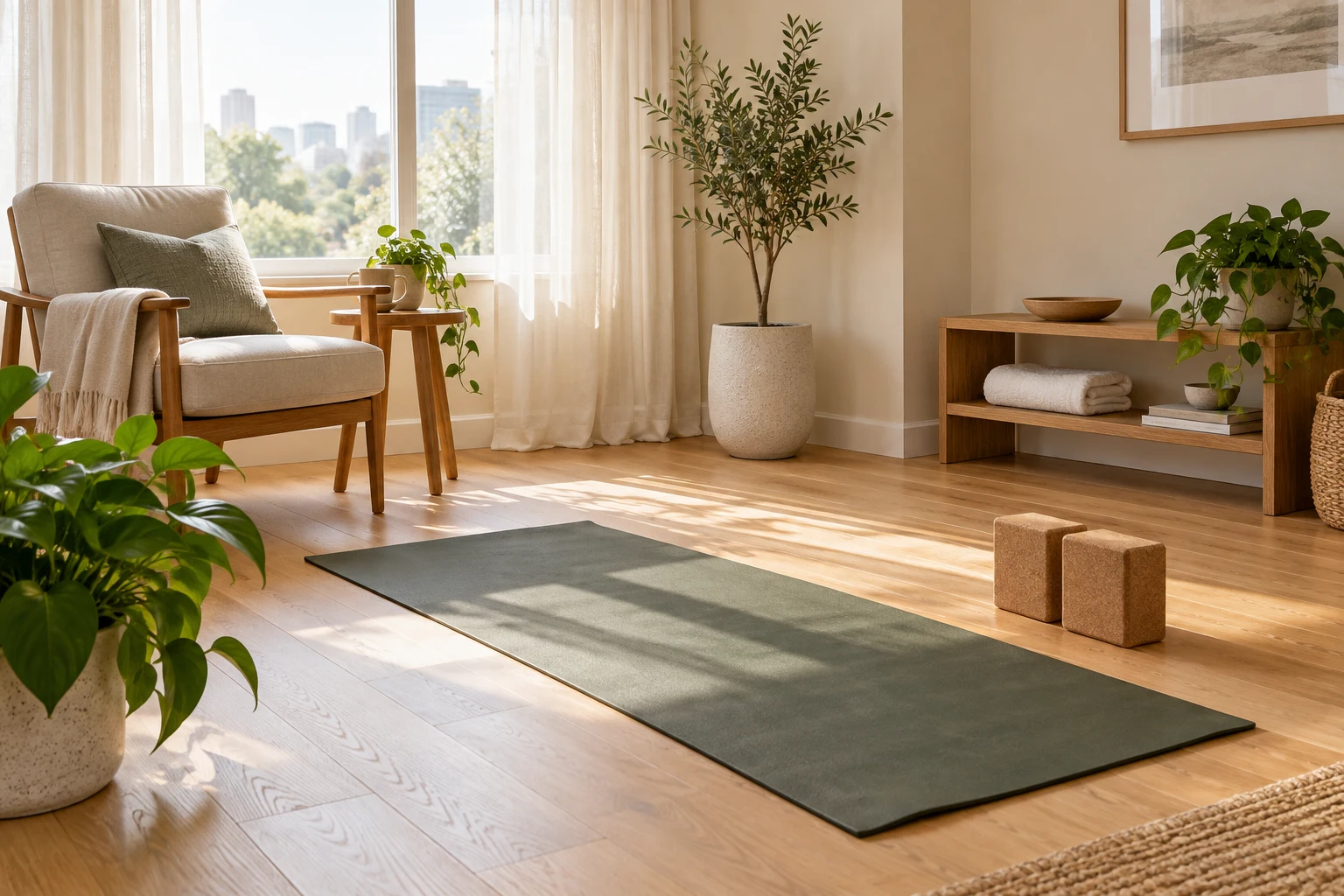
Stand at the entrance and trace how you will reach the practice spot, turn, use support, and leave. Measure usable floor after doors, drawers, furniture, pets, cords, and the sweep of your limbs are considered. Check overhead fixtures and low furniture. A mat outline is not the whole safety zone.
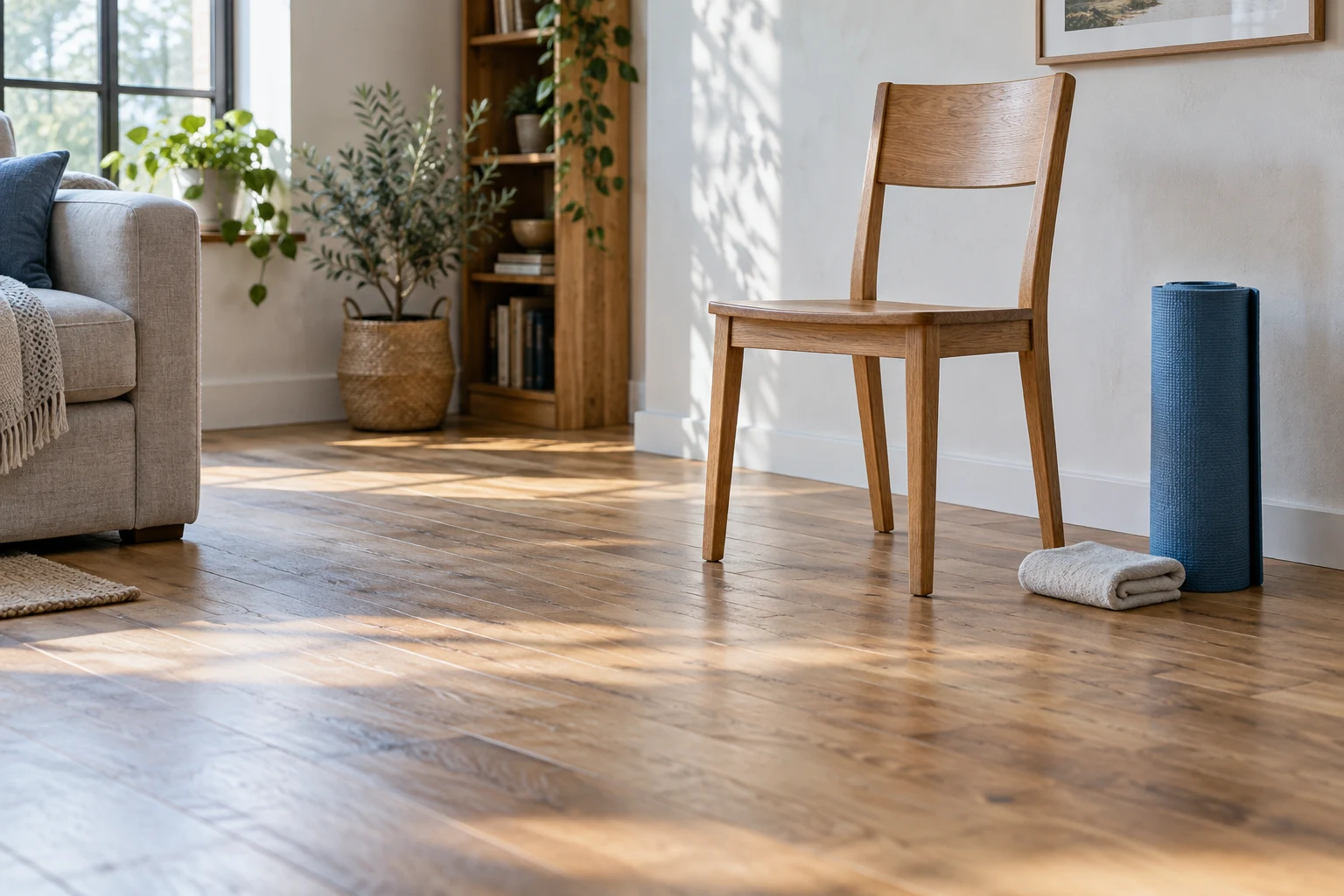
Use a genuinely stable support; if balance is uncertain or support is part of the movement, ask a qualified professional how to use it. A light chair that slides, a rolling table, or a towel bar is not reliable merely because it is nearby. Keep a phone or alert method accessible when appropriate, maintain comfortable light and temperature, and avoid locking yourself into a floor position you cannot leave confidently.
Keep this in mind
- Measure clear length, width, overhead space, and the route in and out.
- Remove cords, loose rugs, clutter, pets, and movable furniture from the path.
- Identify any approved stable support and test that it does not slide.
- Plan how to start and finish without an unreviewed floor transition.
- Keep water, necessary aids, and communication access within reach.
Use a selection map before pressing play
The smallest suitable format depends on ability and context, not ambition. Someone who needs stable hand support may need a supervised standing or seated plan. Someone comfortable on the floor still needs enough space for transitions. A person returning after injury or managing a condition may need clinical rehabilitation rather than a general class.
Ask the reviewer to define the starting position, allowed support, range, pace, rest, and signs to stop. Also ask how an exercise should be changed when the room, energy, or symptoms differ. Those details make a practice adaptable without improvising risky substitutions.
| Current situation | Space requirement | Question to resolve | Format to discuss |
|---|---|---|---|
| Standing feels steady with approved support | Clear stance and reachable stable support | How much hand support is appropriate? | Supported standing practice |
| Floor transitions are difficult or uncertain | Stable chair and clear foot area | Can the goal be addressed while seated? | Seated or chair-supported practice |
| Floor access is confident | Mat plus transition and limb clearance | How should entry and exit be managed? | Reviewed mat-based practice |
| Recent fall, dizziness, pain, or major change | Assessment space | Is a general class appropriate? | Clinical assessment or supervised plan |
Keep the practice legible
Use a reviewed sequence with a clear beginning, middle, and end. Avoid assembling random clips whose transitions and total demand were never considered together. Keep instructions visible or audible without twisting to see a screen. If video pace forces you to rush, pause or choose a format with better control rather than trying to keep up.
One or two simple props may help when they meet an identified need, but every object adds storage, setup, and trip potential. Before buying cushions, sliders, bands, or unstable surfaces, ask what capacity the item changes and whether your reviewer wants that challenge. A clear patch of floor may be the more useful tool.
Sources: American College of Sports Medicine
Review confidence, symptoms, and setup
Afterward, note whether you understood the instructions, used the planned support, stayed within the space, and finished with confidence. Record pain, dizziness, unusual breathlessness, or instability rather than treating them as proof the practice worked. Stop for concerning symptoms and seek appropriate care.
If your plan addresses a health condition or a difficulty with balance, make progression changes with a qualified professional. Keep a note of the duration, support, range, sequence, and setting so you can discuss what felt manageable and what needs to change.
Sources: Centers for Disease Control and Prevention; American College of Sports Medicine
Sources & further reading
Factual guidance is grounded in the sources below. Styling suggestions and decision aids are our editorial interpretation.
- Older Adult Activity: An OverviewCenters for Disease Control and Prevention · Accessed October 1, 2026
- The Future of Fitness: ACSM Announces Top Trends for 2026American College of Sports Medicine · Accessed October 1, 2026
Written with care
Our aim is useful guidance, clear evidence, and considered choices. Found something that needs a second look? Tell us about a correction.